
Background and Rationale
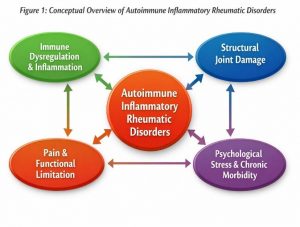 Autoimmune inflammatory rheumatic disorders, particularly Rheumatoid Arthritis (RA) and Spondyloarthritis (SPA), are chronic conditions associated with persistent inflammation, pain, functional limitation, psychological stress, and long-term morbidity. Together, they account for a substantial proportion of chronic pain syndromes encountered in clinical practice. Yet, they differ fundamentally in their underlying pathophysiology—ranging from autoimmune-mediated inflammation and structural joint damage.
These disorders demonstrate variability in clinical presentation, disease progression, and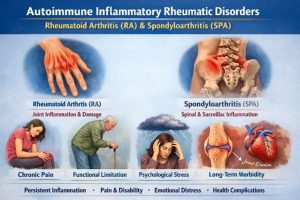 response to treatment, often following a relapsing–remitting course. Chiefly affecting the musculoskeletal system, they are one of the leading categories of chronic diseases affecting working age persons (age group 18-65). They have a significant impact leading to disability of an individual, family and society with loss of productive man hours. With the increase in longevity, the burden will further increase.
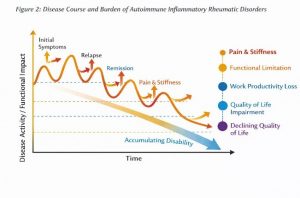 While advances in contemporary rheumatology have improved diagnostic precision and symptomatic control, challenges remain in achieving sustained remission and long-term disease modification. Consequently, patients frequently seek homoeopathic care for chronic management and improvement in quality of life.
From a homoeopathic standpoint, chronic autoimmune disorders require an understanding that extends beyond pathological diagnosis to include host susceptibility, constitutional tendencies, psychological influences, and remedy response over time. Standardised homoeopathy emphasises that long-standing diseases demand deeper insight into the individual constitution and reactivity of the patient, rather than an exclusive focus on local pathology. Roberts in his classic ‘Rheumatic Remedies’ has elucidated an astonishing range of materia medica which needs to be understood in the light of the modern developments.
There is a need to articulate a structured, academically sound, and clinically reproducible homoeopathic approach to the management of RA and SPA that integrates classical principles with contemporary clinical understanding. This symposium is proposed to address this need through systematic case-based analysis and guided academic discussion.
Objectives of the Symposium:
- To underline the clinical approach by examining the clinical presentation, progression, and variability of RA and SPA relevant to homoeopathic practice.
- To correlate clinical findings, laboratory parameters, and imaging features with homoeopathic concepts of disease to infer the state of morbid susceptibility-qualitative (miasmatic) and quantitative in RA and SPA
- To develop a structured approach to case receiving, documentation, and follow-up in these autoimmune inflammatory disorders.
- To assess the role of psychological factors, stressors, and coping patterns in disease expression, activity, and remedy response.
- To apply principles of totality formation, integrating physical, psychological, and general characteristics appropriate to different stages of disease.
- To explore the application of repertorial and non-repertorial approaches to the totality resolution
- To evolve and conceptualise the criteria for the use of constitutional, acute, and intercurrent remedies based on disease activity, vitality, and remedy response.
- To apply principles of posology, including potency selection, repetition and modification in long-term management.
- To understand the contribution of ancillary measures (including diet and physiotherapy) in ensuring an optimal outcome.
- To work towards the development of a clinically consistent, academically defensible, and reproducible homoeopathic framework for the holistic management of RA and SPA.
Methodology:
- The symposium will adopt a structured, case-based-problem solving, academic methodology, emphasising clinical reasoning, documentation, and reproducibility. Case material will be distributed in advance to enable detailed study.
- Well-documented OPD and IPD cases of RA and SPA with one year follow ups will be presented with clearly defined diagnostic criteria, disease staging, and follow-up data.
- Case analysis will emphasise accurate observation, careful evaluation, and rational synthesis, consistent with classical homoeopathic methodology that restoration of health depends upon precise understanding of the patient and disciplined application of therapeutic principles.
- Moderated group discussions will facilitate critical appraisal, comparison of approaches, and refinement of clinical judgment.
- Emphasis will be placed on systematic documentation, longitudinal follow-up, and outcome assessment, aligned with postgraduate academic standards.
Expected Outcomes:
At the conclusion of the symposium, participants are expected to:
- Demonstrate a systematic and reasoned clinical approach to the homoeopathic management of RA and SPA.
- Integrate clinical, investigative, psychological, and constitutional data into coherent and meaningful totalities.
- Realise the advantage of adhering to standards of case documentation and long-term follow-up in these conditions.
- Be able to apply principles of susceptibility, miasmatic understanding, and disease phases in guiding remedy selection and treatment planning.
- Make judicious decisions regarding remedy choice and posology, including potency selection and repetition.
- Objectively evaluate remedy response and modify management strategies in accordance with disease activity and patient response.
- Develop an approach to individualisation that recognises the interrelationship between physical pathology and psychological expression as emphasised in classical homoeopathic philosophy.
- Contribute to the evolution of a standardised academic framework for teaching and clinical practice in homoeopathic rheumatology.
Who should attend?
All practitioners, postgraduates, teachers, research scholars who seek clarity in homoeopathic strategies in the management of RA and SPA through clinical insights, remedy differentiation, miasmatic interpretation, and evidence-based perspectives, thereby strengthening the role of homoeopathy in addressing these challenging chronic conditions with scientific responsibility and compassionate care.
DONATION:
| Before 5th March, 2026 | After 5th March, 2026 | |
| Teachers/Practitioners | 5000/- | 5500/- |
| Students/Interns | 4500/- | 4500/- |
Payment to –
A/c Name: Homoeopathic Education and Charitable Trust
A/c No.: 50100239753191
IFSC Code: HDFC0002256
Bank Name: HDFC Bank, Karjan Branch
VENUE DETAILS:
Venue: Grand Mercure Vadodara Surya Palace
Address:
Grand Mercure Vadodara Surya Palace,
Opp. Parsi Agiary, Sarod, Sayajiganj,
Vadodara,
Gujarat 390020
Accommodation (At the Venue Hotel)
Contact Person: Harish Chander, Associate Director – Guest Relations
Contact: +91 99740 85230 | Harish.CHANDER@accor.com
Special Room Rates (per night)
- Deluxe Room (Twin Sharing): ₹4,900
- Executive Room (Triple Sharing): ₹6,300
Contact Local Coordinator for accommodation in that Area.
SYMPOSIUM TEAM:
| Role | Name | Email ID | Contact |
| Director | Dr. Hitesh Purohit | drhiteshp@gmail.com | 9825592130 |
| Coordinator | Dr. Ami Majmundar | drami.mksh@gmail.com | 9925039779 |
| Coordinator | Dr. Nikunj Jani | drnikunj@gmail.com | 9323180460 |
| Administration: | Dr. Samir Prajapati | drsamir.mksh@gmail.com | 7698515102 |
CENTRE COORDINATORS:
| City | Name | Contact No. |
| Mumbai | Dr. Bhairavi Kothari | 9769971371 |
| Palghar | Dr. Chetna Sakpal | 7058791670 |
| Pune | Dr. Pravin Bhalgat | 77449 79614 |
| Bangalore | Dr. Latha Devarajan | 99451 31115 |
| Raipur | Dr. Sanjay Manwani | 98271 56836 |
| Kolhapur | Dr. Vilas Satpute | 99608 8253 |
SYMPOSIUM FACULTY:
Dr. Kumar Dhawale Dr. S K Phansalkar Dr. A R Kapse
Dr . Sunil Bhalinge Dr. Bipin Jain Dr. Anoop Nigwekar
Dr. Manoj Patel Dr. Mihir Parikh Dr. Hema Parikh
__________________________________________________________________
Hahnemann – Organon of Medicine
Aphorism 3 – “The physician’s high and only mission is to restore the sick to health… He must remove obstacles to cure.”
Aphorism 31 – “The susceptibility of the organism is the fundamental condition for disease.”
Aphorism 210 – “Mental and emotional diseases are to be cured in the same manner as all other diseases.”
Kent – Homoeopathic Philosophy / Materia Medica
“The mental state of the patient often governs the course of the disease.”
“The remedy must be deeper than the disease.”
H.A. Roberts
“Rheumatism is not a local joint disease; it is a constitutional state expressing itself in joints and fibrous tissues.”
— Rheumatic Remedies
“Disease depends not upon the cause alone, but upon the reaction of the patient.”
— Principles and Art of Cure
DATES
12th September to 14th September 2025
16th February – 18th February 2023
31st March – 2nd April 2023